Wednesday, March 23, 2011

The Bridge and Tunnel People

"Hey, Bridge and Tunnel Boy, chill out!" - Man in a crowd of "broker types", in a Manhattan bar to Chris, after he complains of about his rowdiness - The Sopranos (season 2)

"These are nonexistent streets, which do not actually appear until you're standing on the other side of Central Park" - Scott M. Stringer, borough president of Manhattan
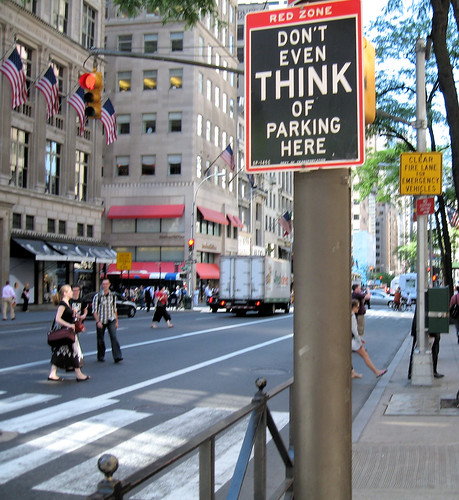
For a spatially dyslexic person such as myself, Manhattan means never having to say you're lost. Well, North of 14th Street that is. South of 14th the place is a nightmarish tangle of streets with names like "Broome Street and "Bowery". Not to mention Greenwich Avenue and Greenwich Street. I can never remember which is which.

I favor north of 14th. There the streets are named with numbers and are laid out in a grid. Streets run east-west and avenues run north-south. I can always find my way.

I do get confused though about "Alternate Side Parking". What does it mean? Luckily I don't have a car. I imagine it means "park on the other side" though, that cannot be right. A tad bit recursive ... "Alternate Side Parking is "suspended on certain days, mostly on religious holy days such as Idul-Fitr and Simchas Torah. Why would this be? So confusing.

I still find it hard to remember that in American, "street" means "road". What we in Australia and in almost every country I've been to, one walks on the street, meaning in American, "on the sidewalk". The road is where the cars go.

Streets and sidewalks are very important to Manhattan people. There has been talk of dividing them into lanes like on highways. There would be a slow lane, reserved for tourists. I think a tourist lane is a good idea.

I wouldn't be surprised if they made a law requiring the bridge and road people to use the tourist lanes. Or perhaps they should be given their own bridge and road lane, as I suspect they walk a little faster than the tourists. Yes we should put them in the middle of the road.
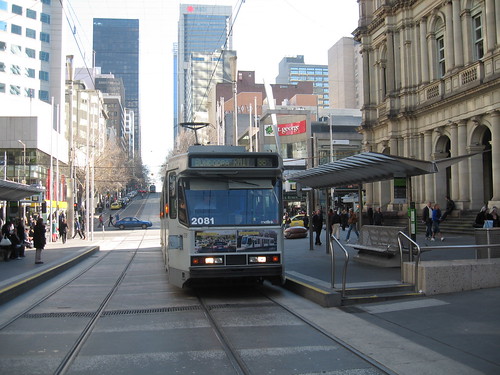
A Melbourne "Road" called "Bourke Street"
Bridge and Tunnel people are people who come into Manhattan via a bridge or a road. People who originate from outside of Manhattan, including the four "outer boroughs" as well as Westchester County, Long Island, Connecticut and New Jersey. In Australia we call such people bogans. In Melbourne we call them "people from Geelong".

Down the middle of Manhattan runs Fifth Avenue. We know it runs north-south because it is called an "Avenue". Anything west of Fifth Avenue is west Manhattan and anything east is east Manhattan. So if someone says, meet me at 323 East 79th Street, you know straight away that it is east of Fifth Avenue and because it is 323, it will be between First and Second Avenues. Furthermore, because 323 is an odd number we know it will be on the north side of the street. Not that I would advise going to 323 East 79th Street to meet anyone. I was there just over a week ago and do not recommend it to anyone who values their cell phone!

There is a special algorithm called a "street locator" which will estimate cross streets for any address on a numbered street in Manhattan. It does not work for downtown streets as they are not numbered. To find the approximate cross street, take the address number and divide by 20; then add (or subtract) the magic number from a table. For example, 660 Madison Avenue would be 660/20=33 plus the Madison Avenue index from the special table (+27), 33+27 = 60th Street. Simple!

Fifth Avenue
Occasionally however things get blurred. Recently when the Manhattan borough president was walking along Fifth Avenue by Central Park he noticed that the bus stop signs were confusing.

A stop across the avenue from East 84th Street was identified as "5 Avenue & West 84 St." Same for all the bus stops along the length of the park.

Now I know the borough president must have been walking south down Fifth, as the park must have been on his right. So HE thought he was in East Manhattan. But it turns out that maybe he was wrong.

As the New York Times put it, "Since these signs sit on the west side of Fifth Avenue, they are technically in the western zone of the street grid. So can West 84th Street exist on the west side of Fifth Avenue, even if the street itself begins on the other side of Central Park?"

I am confused. Who is to say WHERE a street "begins". Also, if the borough president was walking south, on the east side of Fifth Avenue, how could he see the bus signs on the right?

Or is my spatial dyslexia getting the better of me?

I think I'll have to actually go there to understand the borough president's problem. Like I have to turn maps around and face the right direction to navigate whoever is unfortunate to drive in a car with me as a passenger.

Fortunately GPS has solved THAT particular nightmare. I used feel sick in the stomach when some unsuspecting person would ask me to "look at the map".

Stay tuned ...

Sunday, March 13, 2011

The Cell Phone, the Waiter, and the Mink Coat

What I gained by being in France was learning to be better satisfied with my own country. - Samuel Johnson

Now I'm not going to tell you the restaurant's cuisine, and no I don't have a photo of the place. What I DO have is a cartoon that an Australian friend did for me for a LFNY post a hundred years ago. It is sort of apt ...
Friday evening. A Manhattan restaurant.

It'd been a long hard week and the three of us sat down to wine and dine and chat and relax. Which we did. The food was so-so. The wine was good, and if a little pricey, only to be expected. After all, it WAS the Upper East Side. Three New Yorkophiles, two of us Australian. All women. Sitting quietly discussing a range of topics from the Australian film industry to the New York - pre-sanitized New York, before the days of mayors Giuliani and Bloomberg.

Now I've been to restaurants in Europe where patrons plonk their cell phones on the table when they dine out. But even in New York, and especially on the Upper East side, it is definitely not de rigueur to use cell phones in company. But one of us - let's just call her "Lucy" - had just that evening, bought a new 4G Samsung Android phone. As I own the 3G model of the same brand, I'd helped her set it up with the basics when she'd arrived at the restaurant carrying it still in its pink and white T-mobile bag.

Around ten-ish we were starting to get ready to ask for the check when Lucy rummaged in her hand bag for her wallet. I didn't hear her phone ring but it must have vibrated. Or perhaps she just wanted to look at it - it being new. Whatever. In any case Lucy removed it from her bag and stared at it.

Suddenly out of nowhere, one of the waiters swooped on her, and saying how cell phones were banned, snatched it from her hands and proceeded to change the settings.

Lucy was speechless. I was furious. "Don't alter her phone," I complained and he laughed. I insisted, but to no avail. He changed something on it, and only then did he place on the table. He seemed to find the situation très amusant. We didn't. He started to argue with me and then the third member of our party, let's call her "Cordelia", not known for her reticence in calling a spade a shovel, came to my defense. Volubly. It was all too much. The waiter continued to stand there, giggling inanely. The disagreements and the witticisms from the council for the defense on my left, seemed to be never ending. I couldn't handle it. By this stage the restaurant was nearly empty, and I left.

Although I'd told my companions I was leaving, apparently they didn't hear me, and assumed I'd gone to the bathroom.

I found out the next day when we were having our postmortems, that they waited some time before they realized I'd gone. By then the waiters had gathered around the bar. Cordelia gave them a good dressing-down and then she and Lucy called a car service and left.

But that wasn't the end of it. On getting home Lucy decided to look at her new phone in the safety of her own apartment, and was puzzled when she saw she had a very long voice mail. It was no other than the the restaurant conversation between the three of us and the phone-snatching waiter. Quelle horreur! "How had that happened?" she asked me the next morning. I had no idea.

Later, Cordelia phoned to tell me she'd left croissants she'd bought before meeting us at the restaurant. That and a canister of designer tea.

"I'm going back for them," she told me. "Oh no!!" I was aghast.

"I hope it is cold enough. I'll go on Sunday and 'make an entrance'. AND I intend to wear my mink coat," she explained.

I laughed.

And knowing Cordelia, she'll do it with panache!

C'est si bon.

Thursday, March 10, 2011

The Art of Dining in, and of Dining out, in New York

Who bothers to cook TV dinners? I suck them frozen. - Woody Allen

The Next Two Day's Meals
It's taken me sixteen years, but now by George, I've got it. At last, even though it has taken sixteen years, I've got it.

How can people afford to eat, let alone eat out, in New York? It's always puzzled me. And now I know.

I've been content to "order in", cook the occasional meal, and to dine with a friend at a restaurant. But it hasn't been cheap. And yet every day, coming home from work, I pass hundreds of people eating out in restaurants - restaurants that line the streets of Manhattan - so much so that I'm reminded of Kuta Beach in Bali. Where all the world's a restaurant, and all the men and women merely diners.

And then last night, the penny dropped.

I was having dinner with a friend at the retail-up-market restaurant - David Burke's @Bloomingdales. Yes, they've even put the "@" sign on their brand-name in their menu. So 21st century. Well, maybe ....

For some years I have observed that it is apparently socially correct in New York to ask for a "doggie bag" to take home what you cannot, or choose not, to eat. In light of this, I was rather taken by the episode of "Curb Your Enthusiasm", where Larry David is incensed when a waiter insists that the contents of David's "doggie bag" not be given to a dog. Surely, it's implied, a doggie bag from a Michelin-rated restaurant is merely a euphemism, and not to be taken literally.

Yes "doggie bag" means "people-who-want-to-eat-it-the-next-day-bag". At least here in New York. Elsewhere the practice is frowned upon. Indeed, in Australia, if not illegal, it is at least discouraged. There's no "use by" date on doggie bags. Perhaps the restaurant could be sued, should the eater of a doggie bag fall ill, five days after devouring last week's left-overs.

But in Manhattan, who cares about law suits. They're a dime dozen, and so restaurants are only too happy to supply "doggie bags" to diners who are in a hurry and who wish to vacate chairs that can be used for other hungry New Yorkers. After all, it means that the diner will leave without actually eating the stuff. Same price, same profit margin. Less the overhead of flatware and chair "real estate". Let them eat from doggie bags; let them eat at home!

From The Box - David Burke@Bloomingdales
David Burke's has a "Prix Fixe" menu. Good value. Especially if you only want a main course in situ.

Here's the thing - you order the appetizer, the main course, and desert. But you only eat the main course. The rest doesn't even have to make it to the table. "We'll have it at home; please put it in a doggie bag," we ask. And the waiter obliges.

And so a $25 "Prix Fixe" meal serves to feed one for three nights.

It's taken me sixteen years and I've only just begun to understand why so many of my of my fellow New Yorkers can be seen leaving restaurants carrying plastic bags. I HAD thought they were for their dogs ... to clean up after their pets had emptied their bowels. I now know they are containers for their human meals. Forget the dogs! Doggie bags are for human beings!

I'm starting to think that this practice must be based on the premise that we are all equal under the law in America.

Doggies are people too.

Sunday, March 06, 2011

The Baby Boomers' Dream

The soul is born old but grows young. That is the comedy of life. And the body is born young and grows old. That is life's tragedy. - Oscar Wilde

I was dreaming of the past
And my heart was beating fast
I began to lose control - from John Lennon, "Jealous Guy"
When was typing in the title of this post, I hesitated - on where to put the apostrophe. Was I about to write about MY dream - the "Baby Boomer's Dream", or of our collective "Baby Boomer's Dream"? I decided on the latter.

Lately I've been fixated on something that's been increasingly commented on explored and dissected in the American press. It has taken many forms but is best summed up with the rhetorical question, "What has happened to the 'American Dream'?"

Now I really can't remember, but I suspect there's an Australian equivalent of the "American Dream", and that it means more or less the same thing. The idea that for all citizens of America (or Australia), it is possible to own a house, have steady job that pays enough to raise a family of 1.2 kids, and to retire gracefully.

The reason the question is being asked, in America at least, is that along with the recession-depression, have come foreclosures, lay-offs and a reduction in publicly-funded vital services such as education and commuter transport. But was it ever just "a dream" or was it what could be reasonably expected in reality. My guess is that for the bulk of Americans it has always been a dream, and that the reason that journos are decrying the "loss" of the dream, is that the gap between the dreamers and the dreamed is becoming larger, and that they, themselves, are becoming dreamless. And in any case, a dream is just that; a dream.

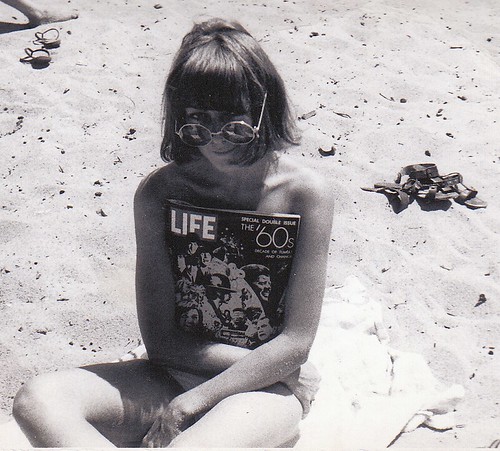
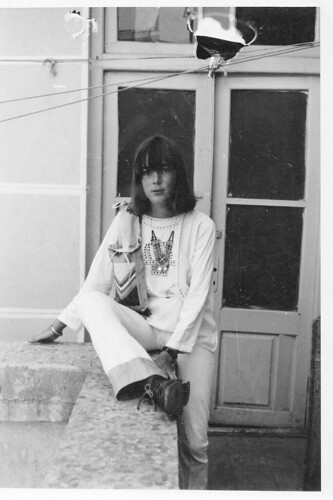
Me, in Iran, 35PF (Pre FaceBook)
But I'm not so interested in the American or the Australian "dream". I AM interested in the baby-boomers' dream. And more so lately as I find more and more of my old peripheral friends popping up on FaceBook. The "lefties" of Sydney and Melbourne. Still going strong. Posting YouTube videos of Jethro Tull and Sonny and Cher songs of the 1970s.

Enabled by Mark Zuckerberg, we are all there, on FaceBook, 'liking' each others' music clips that are all pre-circa-1972. The "summer of love" may be almost 50 years away but we are still around.

We have survived. I'm always amazed when I check an old friend's FaceBook friends. There's invariably someone I knew a hundred years ago. I click the "ask xxx to be your friend" link and to my amazement they always accept my cyber offer. Do they remember me, or do they just look at my profile pic and gauge my age, and being people who were brought up in the fifties and sixties to be polite, accept?

Dylan, aka Robert Allen Zimmerman, has been taken over in interest and in "followers" by Mark Zuckerberg. Ever adaptable, we boomers have overcome! No longer rebels or dreamers, today's young have chosen to conduct their personal and political life in cyberspace. And we have joined them.

I remember marching down St Kilda Road in Melbourne in 1969, protesting against the war in Vietnam. We actually had to leave our houses to do this. Now people can Tweet and FaceBook from the comfort of their own bedrooms.

And I have to hand it to my fellow baby-boomers, we have taken to the new media, and have signed up with Twitter and Facebook in droves.

The American and Australian dreams are still - dreams. The Vietnam war has been replaced by the wars in Iraq and Afghanistan. Public health, public schools and public transport are still being pummeled into non-existance by conservative governments.

Like Cool Hand Luke, we shall not be moved.

We shall overcome.

But will we?

Tuesday, March 01, 2011

Where Did All The Compassion Go?

Where have all the flowers gone?
Long time passing
Where have all the flowers gone?
Long time ago - ©1961 Pete Seeger
Happy happy! - New York Bus People
I am immersed my usual reading daze, sitting on the bus. On my way home from work. Suddenly my concentration is interrupted. Someone has taken a seat one seat away from me, and clunked his backpack on the vacant seat between us. His backpack hits me, but slightly. Enough to wake me from my reading state and I look up.

There's something about the Q32 bus on the west-bound run; the run that transports people from Queens to Manhattan. It is always, well late afternoon at least, partly populated by some very strange people. I've never discovered why, and in the normal course of events it doesn't worry me. But this time it was disconcerting.

I'd seen the man before. He's got some medical condition that causes him to involuntary twitch and move his limbs any which way - inappropriately and uncontrollably. Today he's wearing a threadbare coarse woolen gray coat, and except for the gym shoes, he looks like a character from a Dicken's novel. No teeth. Badly shaven. Tortured. A wild look in his eyes. He has a walking stick. He's about 45. He's one seat away from me and muttering disturbing things like, "God help me I wish I was dead."

Bus Stop
I look around. The bus is three quarters full. Young women are chatting hands-free on cell phones, office workers are gossiping. A business man is reading "New York" magazine. The headline on the cover page is "Are You A Sociopath?". Perhaps I should treat the poor soul a seat away as 'normal'. Maybe that's the politically correct thing to do. His backpack is pressing into my midriff, but I persevere in reading my novel, acting as though all is normal. I have decided not to move to another seat. Why draw more attention to the poor fellow.

Yes, I've seen the man before, so I know the stop where he normally gets off. We are approaching it. I stop reading and look at him. He's trying to concentrate and to gather enough control to stand, to get off when the bus stops. The twitching overwhelms him and he collapses back in his seat muttering, "Please help me!" I pretend to read. The office workers haven't noticed a thing. The cell phone people text and talk.

It's the next stop. Clenching his gums the man manages to stand, and lurching uncontrollably, leaves the bus. It continues on.

New York Women on Bus
At Madison I change buses to go north. There's a line of people, waiting to go north on the M3 bus. I join the line. A few feet to my left is a blind man with a cane. He keeps yelling, "There is no one here; how will I know when the M4 comes?" No one answers. He yells louder. "There is no one here; how will I know when the M4 comes?" The M3 arrives and I'm about four people down-line waiting to get on. No one is answering the blind man, and he's getting louder and more agitated. Eventually I speak up. "We are getting on the M3," I explain. "There is no M4 yet, but one will come and someone will be here to tell you. Right now everyone here is getting on the M3 bus."

But instead of calming him, this just agitates him further. "There is no one here! How will I know when the M4 comes?" he wails.

Dakota Fence Gargoyles
I'm still the only sighted person, the only person answering him. But I'm hassled. "I'm sorry," I reply, "but there are no M4 people here right now; I just cannot manufacture humans for you!" I get on the M3 bus.

"My god," I think to myself. "I'm home. I am a New Yorker again. Compassion has flown out the bus window."

My next bus is a "crosstown". I get on and ask the driver a question, but he just snarls at me and at 72nd and Central Park West I get off. I walk north past the Dakota. It's dusk and for the first time, even though I've walked past it - the building that John and Yoko lived in - many times before, on the very sidewalk where Lennon was fatally shot, I notice for the first time, the gargoyles on its black wrought iron fence. They look evil. Threatening. I hurry on. Too creepy!

And then I arrive. At my therapist's.

Yikes! I am back. In New York.

Sunday, February 27, 2011

A Touch of Blue

What was it like when the world was in black and white? My daughter at age 6,  100 years ago, when seeing a 1950's movie on television.

86th Street Sunday 27 February 2011
Today, Sunday, no snow and blue skies. I ventured out. Manhattan at its best. No snow, no heat. People were out in force and I decided to take some photos. Street scenes. I was out to see the Coen Brothers latest film, "True Grit". I wonder why they don't make a movie set in Manhattan. Or have they?

Will they ever do a Woody Allen type film, with a background of jazz music, or are they just a little bit too much into violence and the America of the primitive backwaters? Whatever, they are brilliant.

Waiting outside the movie theater for my friend, I decided to take some photos of New Yorkers. Random photos. It wasn't till I got home and transferred the photos to my computer that I noticed their lack of color. Apart from the blue jeans and blue skies, everything was black and white.

The morning after - man with eye shades, 2nd Avenue
And it wasn't just today. Yesterday when I ventured out from my normal Saturday of sloth and watching pathetic stuff on TV, I passed this man.

The same black and white with blue jeans. At first I thought he was our neighborhood homeless man, who has been here since we moved here in 2003. But on looking at the photo I notice his recently laundered jeans and his well-heeled shoes. I begin to expect he is one of the Tea Party's "middle class". What has happened to the bourgeoisie? If Karl Marx came back today, would the like of this man be his revolutionary? ASIF!

Melbourne, January 2011
Perhaps I've been too random in my photos. I decide to look back at my photos of last month. Of Melbourne, Australia. Of course I'm being selective.

But who says I have to be objective.

In my mind's eye from here in New York, Australia is a land of sun, of fun, of relaxation and to top it all off, of a decent health care system.

A dream, which however unrealistic, is mine to keep.

Thursday, February 24, 2011

The Drinking Consultants

The Republican McCain-Palin campaign later applied "Joe the Plumber" as a metaphor for middle-class Americans. - Wikipedia
Beer is proof that God loves us and wants us to be happy. - Benjamin Franklin

King and Godfrey's, Lygon Street
Sitting in the Q32 bus on my way home from work. I was absorbed in reading Great House on my Kindle. February, New York. Dusk. I glanced up and stared out the window in front of me.

The sunset was a vivid pink behind a postcard silhouette of the Manhattan skyline. It reminded me of those ghastly "paintings" on velvet that bogan families put on their walls in Australia last century. Those "paintings" of horse heads and pretend Polynesian girls ...

I thought of taking a photo, but would the camera catch the outrageousness of the garish scene? And in any case I was too late. The sunset disappeared as the bus descended from the Queensboro Bridge into the depths of Manhattan.

So soon the Australian-ness of my vibe had gone, and though only five weeks had passed since my trip to OZ, my Australian life was once again, history.

Was I really there just last month? What had I left? A land where "drink consultant" is a profession. Where the Sex Party is a political organization. Where people while away their days socializing. Well that's the impression. And even if it isn't quite true, I like to pretend that it is.

As I walk the streets of Melbourne on my all too infrequent trips back home I'm reminded of Joni Mitchell's "Carey". "And we'll laugh and toast to nothing and smash our empty glasses down."

My friends enlighten me. It isn't all play and no work and in any case, maybe these people you see in outdoor cafés are out-of-towners, tourists. The real Melbourne people are working in offices, earning a quid because everything is so expensive. Right!

Near the Alfred Hospital - Visiting Hours Over - Australians at Play
Late January, 2011. The tellie is full of commentary and scenes of the Queensland floods which were in full force. Television in Australia is becoming like CNN in America. The same scenes, the same interviews played over and over again. The Aussie journo's knack of sniffing out the village idiot in every town, means we have to put up with scenes of little Aussie battlers sitting outside their flooded homes drinking beer. Of hoons on surfboards in rivers that have burst their banks. "Dreadful" say my friends. "What will the rest of the world think of us!"

Corner of Elgin and Lygon, Melbourne
Our Prime Minister Julia Gillard keeps embarrassing everyone by appearing on television in the midst of the flood and its victims, smiling plastically at the camera. I ask my brother, "Is she putting on that accent, trying to sound working class?" "No," he informs me, "She thinks she's talking posh."

I'm reminded of this when back in New York, a colleague tells me that he saw Julia Gillard on television the previous evening. I try to change the subject, as if by hearing about her in a distant land I'm somehow tainted. But he persists. "Is she low class?" he asks. "Probably," I mutter. "She doesn't sound like you," he's saying as I move away.

Universita Restaurant, Lygon Street  Carlton
Yep I'm back. Back in America where there IS no "working class". For my Australian readers - when Obama et al talk of the "middle class" they mean working class and middle class. People who work. The people with blue collar jobs are "low class". Republican states are "red" states. Democrat states are "blue". They've got it backwards. The conservatives aren't "liberals". "Liberal" doesn't apply to economic policy but to social reform and being left wing. Barack is the President's first name and not something you do for your favorite footy team.

The other side of the world seems like the other side of the world. But there is one small mercy.

I don't have to listen to Julia Gillard.

Saturday, February 12, 2011

The Half-Unpacked Case

A large part of travelling consists purely in waiting, with all the attendant ennui and depression. - Damon Galgut, "In a Strange Room"

The first thing that I do when returning from a significant trip away, is to try to keep the feeling. The feeling of being there; "there" being the place I have just returned from.

Even on day-one, I am conscious of the feeling, the touch of the place that will continue to fade into a personal and muted history. I always try, although I know it is in vain, to "keep the feeling", to hold it in my mind, to capture the essence of the experience that grows further away ever minute.

I even have tactics, mechanisms to keep my memories alive. I try to keep, for as long as possible, all physical evidence that I have been away.

First there's the luggage. I used to unpack as soon as I got in the door. But now I do so on an as-needed basis. It is now three weeks since I returned from Melbourne. What's in the case? I take a look. A summer dress I bought at David Jones. It'll need to be dry-cleaned and it is winter here in New York; it can stay there a while longer. A power adapter for my Australian mobile phone. No point in removing it. Summer sandals. An umbrella - Melbourne weather! Summer tops. I close the lid. It is getting painful.

Another tactic is not to pick up my paper mail. To do so is a sign of settling back into the routine of being HERE, not THERE. After a week my ingrained conscientiousness gets to me and I collect it from the box downstairs, sort out the junk, pay bills. The mundane-ness of being back. It's too much. I decide to collect it weekly now instead of daily as I have always done before - perhaps my Melbourne-feeling will stay a little longer.

I keep using my manual toothbrush that I took to OZ. My electric one stays on its base in the bathroom - all dried-up. Good!

I remember I'm meant to call my dentist and make a string of appointments that were interrupted when I left. That can wait.

But I know that soon I'll empty the case, start collecting the paper mail daily. I'll even make dental appointments.

For today I had my nails done at my local nail salon. A routine New York event. Back! The nail polish I'd worn to Australia was growing out anyway. It's gone now, replaced with blue.

I chose the color well.

Monday, February 07, 2011

Falling Out Of Love - With New York

"My one regret in life is that I am not someone else." - Woody Allen

Inside a Melbourne Tram
He said it as one sentence - "How-ya-goin-mate-I-nearly-sconned-you". Sconned - OZ for knocking a persons head off. As in "I was recently sconned in the head with a beer bottle."

He was the Melbourne 200-City-Bulleen bus driver and he had just been forced to brake for a man in double dreadlocks who had walked in front of the bus to get to its door. Unfazed and unsconned, Dreadlocks swiped his ticket and sat down in front of me.

I'd realized the bus driver was a wise guy, when I'd gotten onto the bus and asked whether it went down Johnston Street, which was not far away. "Yes next turn I make is into Elgin Street," he had replied. Adding, "Elgin Street turns into Johnston. Then I turn onto Studley Park Road and go left at Princess, right into Willsmere, left into Kirkby Street. Then I get to Bulleen road and make a right at Thompson's Road, another right at Manningham and then it's right at Williams Road and then I get off and go to the pub for a beer".

I thanked him and smiled. But it was his comment to the nearly-sconned man that got to me. And I think, that's what did it. That's what triggered the memories and the longing.

The laconic irreverence of the stereotypical Australian. Had I heard the same sentence spoken by an actor in an Australian film, or in an ad for Fosters I would have found it over the top; at worse embarrassing, at best ridiculous. But coming from the horse's mouth as it were, it was reassuring. The best and worst of Australia was apparently alive and well.

Australians at Play - Belgium Beer Garden, Melbourne
I few days later I spent several enjoyable hours with my nephew and friend in a beer garden in South Yarra. Around us were hundreds of other people, singles, couples, families ... enjoying a sunny Melbourne day ... doing nothing in particular.

The image of Australians sitting in sidewalk cafés - unhurried, cell phones hidden from view, conversing sans-FaceBook - is engraved in my mind. My vision - although I know it is not representative - of "life back home. Nevertheless it is stamped there. I tend to be like that - easily conditioned, impressionable.

A hundred years ago I was crossing the land border from Pakistan to India. I was leaving a country where I'd had to cover most of my body and a fair bit of my head whenever I ventured out. After looking through my passport the Pakistani border guy motioned me to move on. "Where to?" I asked. "To hell," he replied, pointing to India. I walked on.

My first vision of India then was of a bunch of brightly-colored-sari clad Indian woman sitting on a cart being driven by oxen. I remember distinctly. Their saris were yellow, blue and red, bordered with gold patterns. Their faces were uncovered. They were talking and laughing. I was in India! I was not in hell! Darkness turned to light.


Australian for Politics
Ever since then, when I think about India, I remember those women and the feeling of joy that they evoked. Yes I know there is sadness, poverty and corruption there, but there's also joy. And representative or not, that is the image my brain conjures up, that is my India.

In much the same way, Australia evokes images of warm days relaxing in beer gardens or dining el fresco, of bus drivers unafraid of saying what they think, of lazy hazy days.

Representative or not it doesn't matter. The images are planted firmly in my brain - a yardstick by which other societies will be unjustly no doubt, judged.

New York - you are pretty good - but you are not, my Australia.

Saturday, January 01, 2011

Yesterday's Laundry

What if nothing exists and we're all in somebody's dream? Or what's worse, what if only that fat guy in the third row exists? - Woody Allen

Central Park West, Last Days of 2010
2011. Who would have thought it. Yet here we all are. And what's more, I am now a member of a generation that is, as some patronizingly put it, "entering into a new window on life, the Third Age".

"You know how there's all sorts of groups," my brother told me a few weeks ago. "Like Asian, Jewish, boys, girls, black, white and so on. Well I always thought you couldn't cross from one to another; you had your "'group'. And I saw 'old people' as one such a group. A group I'd never belong to. And now I'm one of them!"

I feel the same way. Sometimes I try to see the positives of getting older. We are supposed to become wiser, more mature, tolerant and kind. Pop psychologists would have us self actualized, knowing and accepting who we are, understanding ourselves ...

Well Mr Maslow et al, you obviously don't live in New York. It is pretty pretty hard to know oneself in THIS apple.

Dry Cleaner's Laundry Bag 
Take the other day for example, when I dropped by the local dry-cleaners to see why my laundry had not been delivered. Our dry-cleaning is dropped off at the building's lobby in a dry-cleaner-supplied yellow bag. It's then picked up that evening and returned by the dry-cleaner to the lobby once it's ready. Mine hadn't come back, so around day 3 I walked to the dry-cleaners and asked about it.

"Name?" he asked and I gave it. "Very sorry, is no such name," he said. "But I am telling you my name and you have been taking my stuff and charging my credit card for years," I complained. On and on it went. Until I remembered he'd misspelled my name on the tag, and so he'd probably done the same thing when he'd entered it into his computer.

Without my laundry bag I could not recall HOW he'd spelled my name. I tried all sorts of variations while he looked at me pityingly. "You do not know your name," he was saying.

Eventually I got it right. K-A-T-H-E-L-E-E-N. So that's who I was Ms Katheleen. I'd thought I was Kathleen Juliff. Silly me!

It wasn't as if it was the first time I'd had an identity problem. A few months ago I went to a new pharmacy. Before I could get my prescription filled I had to give the pharmacist identifying information, including my date of birth.

When I returned to pick up the prescription, I was asked for my date of birth. I mumbled it back but he couldn't hear. I was forced to shriek it out for the whole pharmacy to hear. "Oh well, who cares," I was thinking, only to hear that I had it wrong. "Sorry," said Mr. Pharmacist, "you got it wrong. It is 1/1/1980." "Clearly it is not," I insisted. "That's what the computer tells me," he answered with an air of triumph. "I suggested he'd mistyped it in, in the first place. But he was not to be convinced. See, I don't even know when I was born, let alone my name.

Several years ago I opened a new account at Chase Bank. The bank manager transcribed my credentials from the form I'd filled in, to the computer. The branch in question happens to be in the same building - same street number and street - as our apartment.

Doorman shoveling snow, December 2010
A week later I received a letter from the bank saying the account was declined as the address was the address of a milliners, and was not an apartment block. A milliner!!!! Obviously they had a very old street directory I hissed. And anyway the branch was at the same address and didn't sell hats.

I showed the letter to the bank manager but he just shrugged. Obviously I didn't know where I lived.

Eventually the bank conceded that my address was my address, but explained that the account was still declined because my Social Security number was incorrect. I took the elevator upstairs and found my blue Social Security Card. The original. I showed it to the manager who checked again. "Incorrect, you'll have to contact Social Security!" was all I could get from him. "The computer has a completely different number in it." I wasn't me after all.

In the end it was sorted out. I was allowed to give the bank my money.

What's WITH these people. What's with ME?

Who am I?

I am Kathleenwng and I approve this message.